
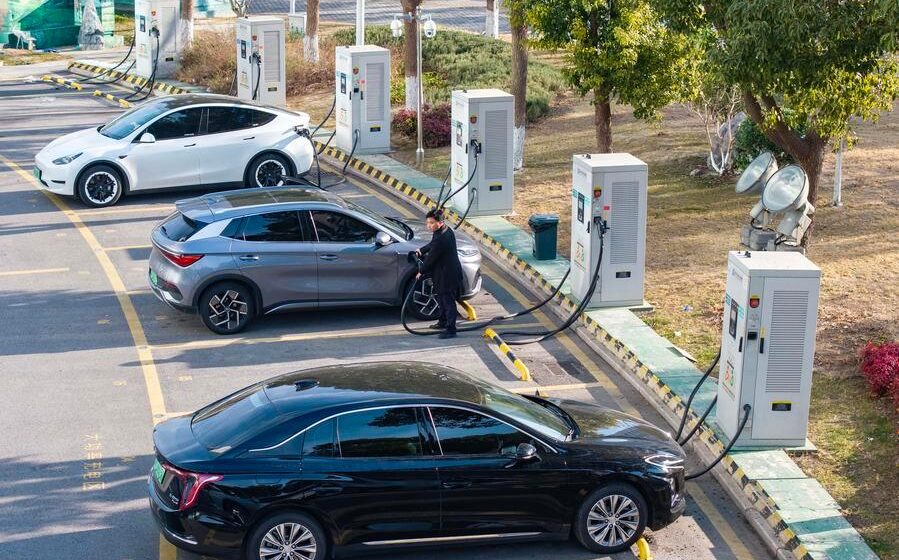

China recorded a record 28.05 million kWh of electricity consumption at expressway EV charging stations on October 1, the first day of the National Day holiday, as electric vehicle traffic surged across the country.
The National Energy Administration (NEA) said the figure was 60.4% higher than the 17.49 million kWh recorded on the same day last year, making it the highest single-day holiday charging figure on record.
However, the increase partly reflects the expansion of the charging network monitored by the national platform.
The number of monitored charging connectors rose from 48,400 last year to 62,700 this year, a 29.5% increase.
On a per-connector basis, charging rose by about 23.8%, from 361 kWh to 447 kWh, providing a clearer measure of increased demand.
Between October 1 and 3, monitored chargers handled 2.97 million charging sessions, up 48.4% year-on-year, and delivered 71.62 million kWh, a 49.4% increase.
Despite the surge, some motorists faced long queues at highway service areas. Chinese media reported waits of several hours at some charging stations, while State Grid deployed 599 temporary charging connectors and 32 mobile charging trucks at busy locations.
China had approximately 89,000 charging connectors at highway service areas, including about 22,000 high-power units, as of September.
Nationwide, the country had 24.22 million charging connectors of all types by the end of August, up 39.6% year-on-year.
The surge in charging demand came despite a recent slowdown in new-energy vehicle sales.
Retail sales of new-energy passenger vehicles fell 20% year-on-year to 827,000 between September 1 and 27, although such vehicles still accounted for 65.7% of total passenger-car sales.
Battery swapping was not included in the NEA figures. Nio alone recorded 183,469 battery swaps on October 1, highlighting additional demand from electric vehicles not captured by charging statistics.
China’s government aims to increase the country’s charging network to more than 40 million connectors by 2030, including about 300,000 high-power units.