
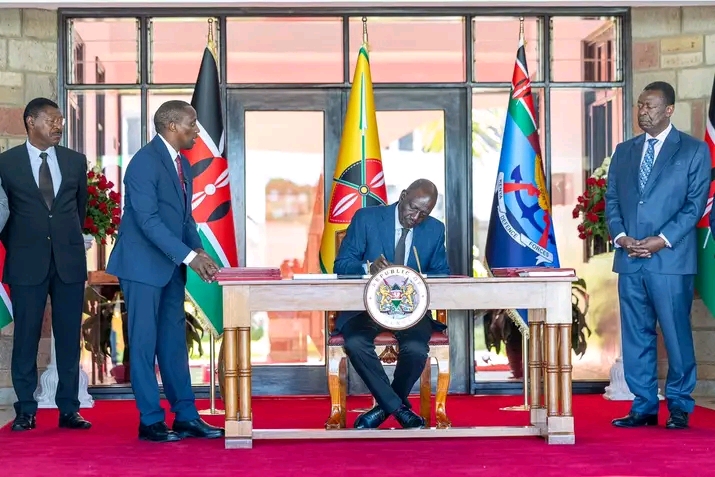

President William Ruto has signed two tax laws introducing changes to fuel taxation, construction materials and the governance of the Kenya Revenue Authority (KRA), in measures that could influence household spending, business operating costs and the cost of building homes.
The legislation, comprising the Value-Added Tax (Amendment) Bill and the Kenya Revenue Authority (Amendment) Bill, comes as households and businesses contend with fuel-price pressures, rising production expenses and the high cost of construction.
The changes seek to cushion consumers against international oil-market disruptions while adjusting the tax treatment of selected building materials and strengthening coordination between tax collection and port operations.
Deputy Chief of Staff Josephat Nanok briefed the President on the legislation, which is expected to have implications for motorists, transport operators, manufacturers, property developers, contractors and ordinary consumers.
Fuel VAT Reduction Offers Temporary Relief to Households and BusinessesUnder the VAT legislation, petrol, diesel and paraffin will retain a reduced VAT rate of 8 per cent for an initial 90 days, with a possible extension for another 90 days if the situation in the Middle East does not improve.
The reduced rate is half the standard VAT rate of 16 per cent and is intended to limit the tax burden on petroleum products amid uncertainty in international oil markets.
During the briefing, an official explained that the reduced VAT rate had already been factored into the latest fuel-price announcement by the Energy and Petroleum Regulatory Authority (EPRA).
“Had that 8% not been factored, the price of fuel announced by EPRA was going to be higher than announced,” the official said.
The legislation is deemed effective from midnight on October 14, 2026.
For Kenyan households, fuel taxation has far-reaching implications because petroleum costs influence public transport fares, food distribution, electricity generation costs in some settings, manufacturing and the delivery of essential goods and services.
A reduction in the tax component could help moderate these expenses, particularly for low- and middle-income households that spend a significant share of their earnings on transport and food.
Transport operators, farmers, manufacturers and small businesses that depend on fuel could also benefit if the reduced tax helps contain operating expenses.
However, the relief does not guarantee a fall in pump prices or transport fares. International crude oil prices, the exchange rate, distribution costs and other components of the fuel-pricing formula will continue to influence prices.
For consumers, the immediate benefit will therefore depend on whether the tax relief offsets increases in other fuel-cost components.
The 90-day period also creates uncertainty for businesses planning their budgets.
Unless the relief is extended, the applicable VAT rate could return to the standard rate, depending on the law in force at the time.
Construction Tax Changes Could Affect the Cost of Building Homes
The VAT law also introduces changes to the taxation of selected construction materials, with potential implications for developers, contractors and households planning to build homes.
Under the new measures, tax applicable to construction tiles will be calculated at KSh400 per square metre, replacing the previous weight-based measurement.
Taxes on ceramic fittings, including sinks, will fall from KSh50 per kilogramme to KSh30 per kilogramme.
The legislation also provides for imported float glass from East African countries to be treated like locally produced glass, a measure intended to support local industry and construction.
The adjustments could influence the cost of materials used in residential housing, commercial buildings and other infrastructure projects.
For households saving to construct homes, lower taxes on selected materials could offer some relief at a time when land, labour, financing and building supplies account for a substantial share of construction expenses.
Property developers could also benefit from changes that reduce the tax burden on particular inputs, potentially improving project viability and easing some cost pressures in the housing market.
The construction sector is closely linked to employment and livelihoods, supporting artisans, masons, plumbers, electricians, transporters, hardware shops and manufacturers.
Changes in material costs can therefore affect not only property prices but also demand for labour and related services.
However, the overall effect on housing affordability will depend on how suppliers and retailers adjust their prices.
Savings on selected materials may have a limited impact on total construction costs if other inputs remain expensive.
For households, the key question will be whether the tax adjustments translate into lower retail prices for tiles, ceramic fittings and other affected materials.
KRA Board Reforms Target Revenue Collection and Port Operations
The Kenya Revenue Authority (Amendment) Bill changes the composition of the revenue agency’s board, with the stated objective of strengthening coordination between tax collection and port operations.
Effective coordination between revenue authorities and port operations is important for businesses involved in importing and exporting goods, particularly manufacturers and traders whose operations depend on the timely clearance of cargo.
Improved coordination could help reduce administrative delays, strengthen oversight and improve the efficiency of revenue collection if the reforms are implemented effectively.
For businesses, faster and more predictable clearance processes could reduce some of the costs associated with delays, storage and disrupted supply chains.
Such improvements could also support trade and improve the movement of goods into and out of the country.
However, the practical benefits will depend on how the changes are implemented and whether they lead to measurable improvements in customs administration and operational efficiency.
The board changes do not, on their own, guarantee lower import costs or faster cargo clearance.
What the Tax Changes Mean for Kenya’s Economy
The two laws address areas that directly affect the cost of living and the operating environment for businesses.
The reduced fuel VAT rate offers temporary tax relief during a period of international oil-market uncertainty, while the construction-material adjustments could ease some expenses for homebuilders and property developers.
The KRA governance changes, meanwhile, seek to improve coordination in revenue administration and port operations, with potential benefits for businesses that rely on imports and exports.
The broader economic impact will depend on whether the measures translate into lower consumer prices, reduced business expenses and more efficient trade processes.
For ordinary Kenyans, the most important measure of success will be the effect on household budgets.
Lower fuel-related costs could help moderate transport and food expenses, while cheaper construction materials could make homebuilding more affordable.
For businesses, the benefits will depend on the extent to which tax relief reduces operating costs, supports investment and protects profit margins without creating additional uncertainty when the temporary fuel-tax arrangement expires.
Ultimately, the legislation’s impact on livelihoods will be determined not only by the tax changes themselves but also by market pricing, implementation and the government’s decisions when the initial relief period ends.