
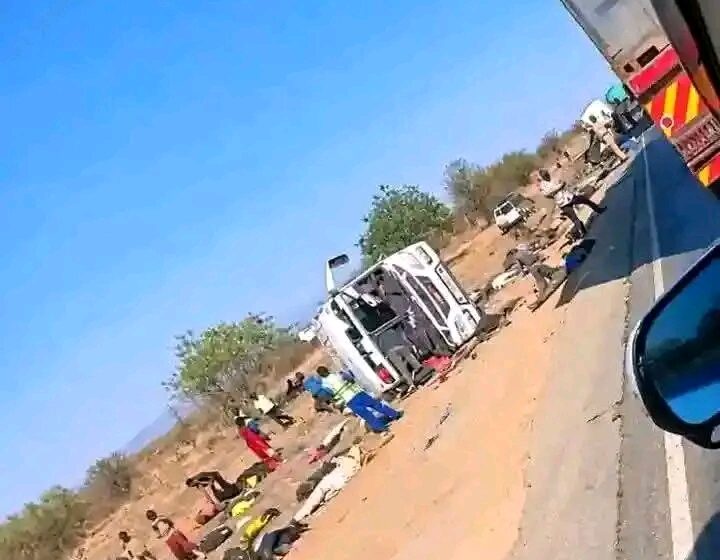

The ghostly lorries, the missing drivers, and the mysterious journey of DRC minerals to Dar es Salaam.
“Ukiona malori sita yenye taa za bluu usiku, usisimame. Hizo si gari za watu walio hai.”
If you see six lorries with blue headlights at night, do not stop. Those are not vehicles carrying the living.
That is the chilling warning whispered among long-distance truck drivers at roadside petrol stations along the Nairobi–Mombasa highway. Around Voi, Mtito Andei, and Mariakani, some old drivers speak of a terrifying apparition known as Msafara wa Wafu — The Convoy of the Dead.
Nobody knows exactly when the legend began. Yet those who tell it insist on one thing: the story always ends with a missing driver.
Years ago, they say, a lorry carrying workers from the Coast broke down on a lonely stretch of highway. Moments later, a horrific crash transformed the darkness into a scene of blood, twisted metal, and dying screams. By sunrise, the wreckage had been cleared and the road reopened.
But one driver was never found.
According to the legend, his blood seeped into the tarmac, and with his final breath, he cursed the highway: no driver would ever cross that stretch again without confronting the dead.
Since then, truckers have whispered about a black lorry that appears at precisely 2:13 a.m. It has no registration plates, no company markings, and six blue headlights that burn through the darkness like supernatural flames.
One night, a driver named Juma was transporting a consignment of coltan from the Democratic Republic of the Congo towards the Coast. Near Mtito Andei, his radio crackled.
“Juma, fungua mlango.”
Juma, open the door.
He froze. The voice belonged to his mother, who had been buried in Kilifi three years earlier.
Before he could respond, three knocks came from inside his sealed cargo container.
Knock. Knock. Knock.
Juma stared into his rear-view mirror. Sitting beside him was a little girl wearing a bloodstained school uniform. Her neck hung at an impossible angle, and muddy water dripped from her bare feet onto the cabin floor.
“Mjomba,” she whispered, “mbona ulituacha?”
Uncle, why did you leave us?
Juma screamed and swerved. His headlights swept across the roadside, revealing dozens of silent figures standing in the rain. Some carried torn travel bags. Others clutched funeral flowers. All were barefoot, pale, and motionless.
Then the black lorry pulled alongside him.
Behind its steering wheel sat another Juma.
His face was decomposing. His eyes were black as charcoal. Blood trickled from the corners of his mouth.
The apparition smiled and pointed towards the empty passenger seat.
By dawn, Juma’s lorry stood abandoned. The cargo remained untouched, but the cabin reeked of fresh blood. Across the windscreen, four words had been written in crimson:
“Mmoja lazima abaki.”
One must remain.
Juma was never seen again.
THE MYSTERY OF THE MISSING CONVOY.
Today, the legend has acquired another unsettling dimension: why do so many mineral shipments from the DRC travel towards the Indian Ocean through Tanzania rather than Kenya?
The answer lies in geography, infrastructure, and established trade corridors. Kalemie, an inland port on Lake Tanganyika, connects with regional transport networks, including routes through Kigoma and Tanzania’s Central Corridor towards Dar es Salaam. For some mineral-producing areas in the DRC, these routes offer established logistical connections to the Tanzanian coast.
But the ghost-story version is darker.
Some truckers joke that certain cargoes are not merely heading to the port. They are following a road chosen long before the living learned to read maps.
And on moonless nights, when the highway falls silent, drivers claim they sometimes see six blue lights approaching through the rain.
If your radio suddenly calls you by name, remember the warning:
Usijibu. Usisimame. Usiangalie nyuma.
Do not answer. Do not stop. Do not look back. Because the most terrifying thing on the Nairobi–Mombasa highway may not be the black lorry approaching from behind.
It may be the dead passenger sitting beside you, breathing against your ear, waiting for you to notice that their reflection disappeared from the mirror several kilometres ago.
Tukutane Dar es Salaam…