

The United Democratic Alliance (UDA) remains Kenya’s most popular political party, while President William Ruto leads the presidential race with 40.2 per cent support, according to a new survey by Swiss Poll International.
The survey, conducted between October 19 and October 22, placed UDA at 36.1 per cent in party popularity, ahead of the Linda Mwananchi movement, which emerged second with 16.1 per cent.
The findings also point to growing competition within the opposition, with support spread across several political figures, while a significant number of Kenyans remain undecided about their political affiliations.
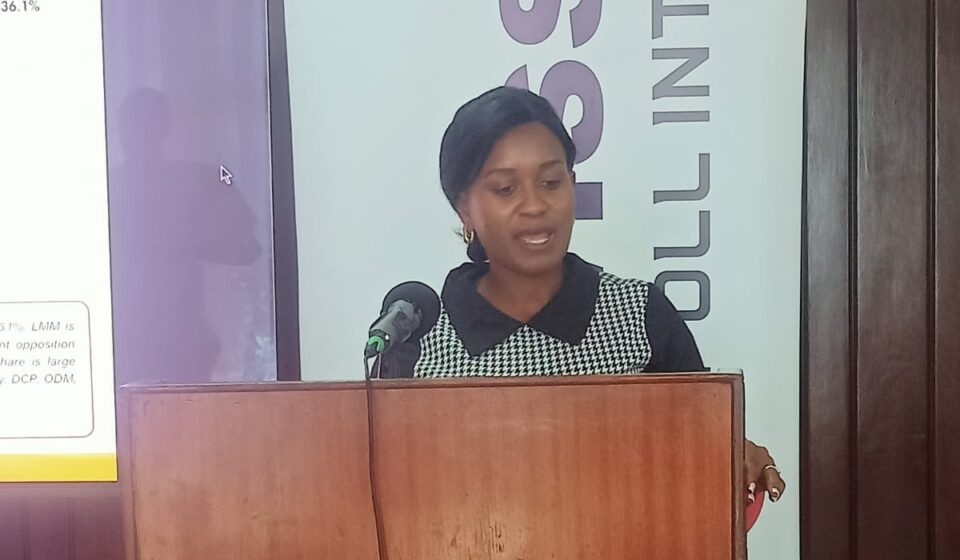
Speaking while presenting the findings, Swiss Poll International Data Reporting Officer Ziporia Kawomile said the survey involved 6,146 respondents drawn from across the country.
The poll had a margin of error of 1.8 percentage points and a 95 per cent confidence level.
“We examined party popularity across the country, presidential preferences and public perceptions of the direction in which the country is heading,” Kawomile said.
UDA maintains lead as Linda Mwananchi gains ground
UDA maintained its position as the country’s leading political party, followed by the Linda Mwananchi movement at 16.1 per cent.
Other parties, including Democracy for the Citizens Party (DCP), the Orange Democratic Movement (ODM), Wiper Patriotic Front and Jubilee, trailed behind the two leading formations.
Kawomile noted that the Linda Mwananchi movement had established a notable support base despite being a relatively new entrant into the political scene, outperforming several established parties in the survey.
However, 12 per cent of respondents remained undecided about their preferred political party, highlighting a sizeable pool of voters whose support could influence future political contests.
The survey also found that party popularity varied significantly across regions.
UDA recorded its strongest support in the Rift Valley, although it maintained a presence in other parts of the country. The Linda Mwananchi movement performed strongly in Western Kenya and Nairobi, while DCP enjoyed its highest popularity in the Central region.
ODM remained strongest in Nyanza, reflecting the continued influence of regional political loyalties in shaping party support.
Ruto leads presidential race with 40.2pc
In the presidential preference rankings, Ruto emerged as the leading candidate with 40.2 per cent support.
Wiper leader Kalonzo Musyoka came second with 19.7 per cent, followed by Nairobi Senator Edwin Sifuna at 17.6 per cent.
Former Deputy President Rigathi Gachagua ranked fourth with 7.5 per cent, while other candidates, including Fred Matiang’i and Kiharu MP Ndindi Nyoro, trailed behind.
Despite Ruto’s lead, Kawomile cautioned that his support remained below the 50 per cent mark, suggesting that the president would need to consolidate and expand his political base to strengthen his position ahead of the next General Election.
“The fact that he is leading does not mean he should relax. His support is still below 50 per cent, so there is room for him to strengthen his political support,” Kawomile said.
The survey also pointed to fragmentation within the opposition, with several candidates attracting substantial but divided support.
According to Kawomile, opposition candidates would need to consider strategic alliances if they hope to mount a stronger challenge against Ruto.
He argued that cooperation among at least three candidates or political formations could help consolidate opposition support and potentially overtake the president’s current 40.2 per cent.
The regional breakdown of presidential preferences largely mirrored party popularity patterns, with Ruto leading in the Rift Valley, while Sifuna performed strongly in Western Kenya and Nairobi.
Majority of Kenyans say country is headed in wrong direction
Beyond political preferences, the survey found that a majority of respondents were dissatisfied with the country’s direction.
Some 52.7 per cent said Kenya was heading in the wrong direction, compared with 38.4 per cent who believed the country was moving in the right direction. Another 8.9 per cent were undecided.
Respondents who felt the country was on the wrong path cited the high cost of living, unemployment, corruption, poor governance, challenges in healthcare and difficulties in the education sector.
Those who viewed the country’s direction positively pointed to ongoing economic projects, infrastructure development, education reforms and improvements in healthcare as reasons for their assessment.
The findings highlight the challenge facing the government as it seeks to maintain political support amid public concerns over the economy and service delivery.
With a significant proportion of voters yet to settle on their preferred political parties, the survey suggests that both the ruling coalition and opposition formations still have an opportunity to influence public opinion as the country moves towards the next electoral cycle.