
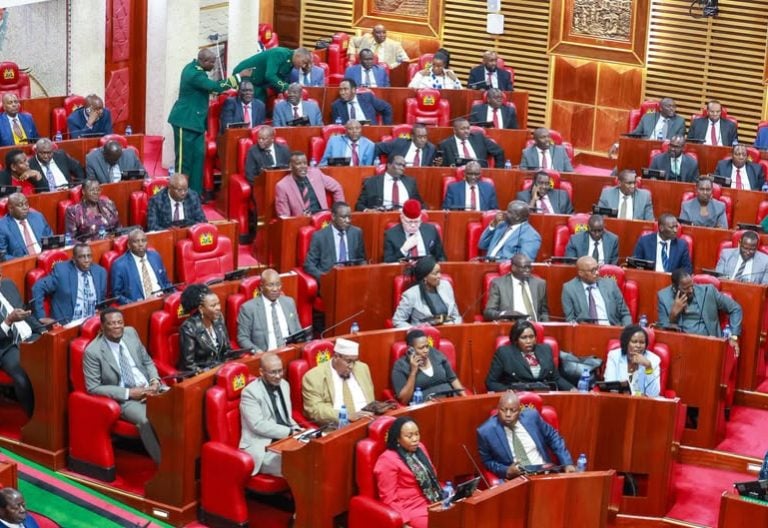

The battle over proposed changes to Kenya’s electoral laws is heading back to the Senate, with Parliament insisting that the requirement for the Independent Electoral and Boundaries Commission (IEBC) to livestream election results remains intact.
The Elections (Amendment) (No. 2) Bill, 2024, was referred back to the Senate after the National Assembly passed it with amendments on October 22, 2026, reopening debate over proposed reforms ahead of the 2027 General Election.
In a clarification issued after the vote, Parliament dismissed reports that the amendments would remove the legal requirement for livestreaming election results, saying MPs had retained the provision requiring the IEBC to establish a livestreaming mechanism.
“The National Assembly retained the requirement for the IEBC to establish a mechanism for the livestreaming of election results,” Parliament stated.
The clarification followed reports suggesting that the removal of a controversial clause in the Bill could weaken legal provisions on the public broadcasting of election results.
Parliament maintained that deleting the clause preserved the existing provision under Section 39 of the Elections Act.
Bill returns to Senate
The Bill had previously been passed by the Senate with amendments before being transmitted to the National Assembly for consideration.
Following its review by the Departmental Committee on Justice and Legal Affairs, the National Assembly approved the proposed law with further amendments, triggering another round of consideration by the Senate under Article 110(4) of the Constitution.
The Senate will now consider the amendments made by the National Assembly as Parliament works towards resolving the outstanding issues before the Bill can proceed through the legislative process.
The proposal underwent public participation, including consultations with stakeholders such as the IEBC.
What the proposed law seeks to change
Beyond the livestreaming debate, the Bill proposes changes affecting voter registration, political party primaries, nominations, the right of recall, by-elections and the resolution of electoral disputes.
On voter registration, the proposed amendments seek to make the voters’ register available for inspection at all times, except during designated periods.
The Bill also proposes removing the IEBC’s role in political party primaries while revising provisions governing the recall of elected representatives to align with the Constitution.
On nominations, the proposed changes would give political parties greater flexibility in selecting candidates for elective positions and party-list seats.
The Bill further proposes suspending voter registration only in the area affected by a by-election, with newly registered voters barred from contesting in that particular by-election.
On electoral disputes, Parliament says the amendments are intended to promote substantive justice, fairness and accountability in the resolution of cases.
Livestreaming versus electronic transmission
The controversy has also highlighted the difference between livestreaming election results and electronically transmitting results to election officials.
Livestreaming allows members of the public to watch results being announced in real time, while electronic transmission involves sending election results through digital systems to designated election officials or tallying centres.
Although the processes serve different purposes, both have featured prominently in discussions about transparency, accountability and public confidence in elections.
Parliament’s clarification addresses the concern that the National Assembly’s amendments could eliminate the express requirement for livestreaming.
However, the final position will depend on the outcome of the parliamentary process and the wording of the enacted law.
With the 2027 General Election approaching, the Senate’s consideration of the amended Bill will be closely watched by political parties, election stakeholders and voters seeking clarity on the rules governing electoral administration, candidate nominations and dispute resolution.
The Bill remains under consideration, meaning the proposed reforms have not yet completed the legislative process.