
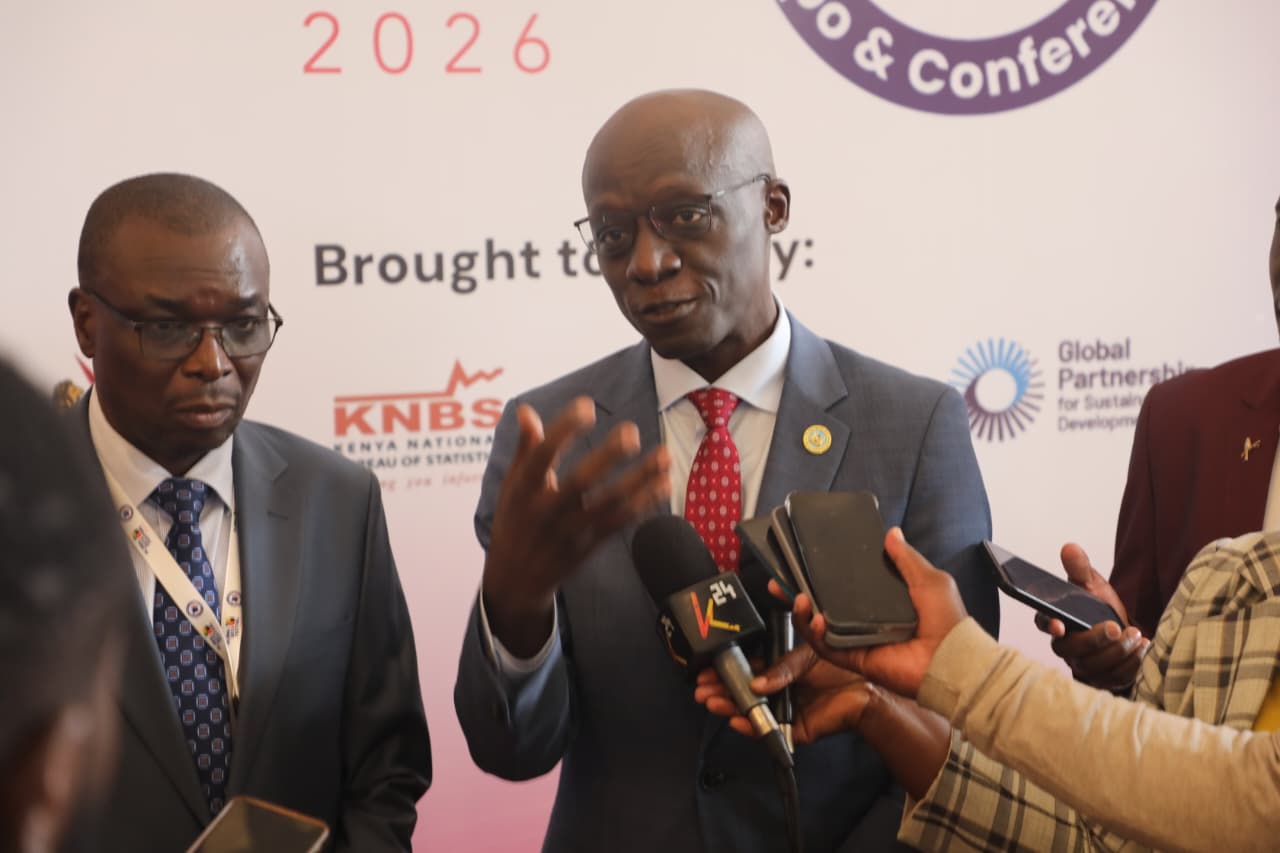
Kenya Sounds Alarm on Africa’s Data Gap as Global Data Festival Opens in Nairobi

As the global race for artificial intelligence accelerates, leaders gathering in Nairobi have delivered a stark message: Africa risks being left behind unless governments dramatically increase investment in data systems, satellite infrastructure and digital innovation.
The warning came as Kenya hosted the first African edition of the Global Data Festival alongside the Kenya Space Expo and Conference, bringing together more than 1,000 delegates from over 60 countries to tackle one of the continent’s biggest development challenges — the lack of reliable, accessible and actionable data.
For policymakers and technology leaders, the issue is no longer academic. Data has become the fuel powering AI, economic planning, climate resilience, healthcare delivery and investment decisions. Without it, experts warn, countries will struggle to compete in an increasingly digital global economy.
“Statistics are more than just numbers. They are a mirror of society,” said Kenya National Bureau of Statistics Director General Dr. Macdonald Obudho. “A good mirror does not flatter; it shows who we are, what we have achieved and, most importantly, who we are leaving behind.”
His remarks highlighted a growing concern among development experts: millions of Africans remain effectively invisible in national datasets, making it harder for governments to design policies that address inequality, poverty and access to essential services.
Kenya’s own experience demonstrates the power of better data. A national Time Use Survey revealed that women spend four times longer on unpaid care work than men, findings that directly influenced the country’s National Care Policy. Similar data-driven approaches are now being used to improve support for persons with disabilities and other vulnerable populations.
But officials argue that traditional statistics alone are no longer enough.
Artificial intelligence, citizen-generated data and real-time digital information are rapidly transforming how governments understand their populations. At the same time, satellite technology is emerging as one of the most powerful tools for generating insights at scale.
The convergence of the Global Data Festival and the Kenya Space Expo reflects that shift.
Kenya Space Agency Director General Brigadier Hillary Kipkosgey said Earth observation satellites are becoming critical infrastructure for modern economies, generating data that can help governments predict droughts, monitor crops, manage natural resources and respond to disasters.
“Satellites generate enormous amounts of information that help us understand what is happening on Earth,” he said.
Kenya is investing in ground stations and international partnerships, including collaborations with the Italian Space Agency, as it seeks to strengthen its position as a regional hub for space-derived data and geospatial intelligence.
The discussions come at a pivotal moment. With only a few years remaining to achieve the United Nations Sustainable Development Goals, governments are under increasing pressure to use technology more effectively to close development gaps.
Special Envoy on Technology Ambassador Philip Thigo argued that the next frontier lies in unlocking data held by both governments and the private sector.
“The private sector generates vast amounts of valuable information,” he said. “The challenge is creating mechanisms that allow data sharing as a public good while protecting privacy and ensuring the data benefits citizens, businesses and governments alike.”
That challenge has become even more urgent as AI systems increasingly depend on large, high-quality datasets. Without stronger data-sharing frameworks, experts say many African countries could struggle to develop competitive AI ecosystems and digital economies.
The economic case for investment is becoming harder to ignore.
According to the Global Partnership for Sustainable Development Data (GPSDD), every dollar invested in data systems generates an average return of $32 through improved planning, more efficient public services and better investment decisions.
“Every data point represents a person, and every pixel represents a place, a community and a life,” said GPSDD Chief Executive Officer Jenna Slotin.
She noted that investors increasingly view trusted national data systems as essential infrastructure, using them to assess risks, identify opportunities and allocate capital.
The impact is already being felt at the local level.
Vihiga Governor Dr. Wilber Ottichilo said counties are increasingly relying on geographic information systems (GIS), satellite imagery and demographic analytics to guide decisions on healthcare, land use and urban development.
In Vihiga, geospatial analysis helped identify underserved communities and determine where new health facilities should be built based on actual population needs rather than political considerations.
“We cannot effectively govern our counties without credible data,” Ottichilo said.