
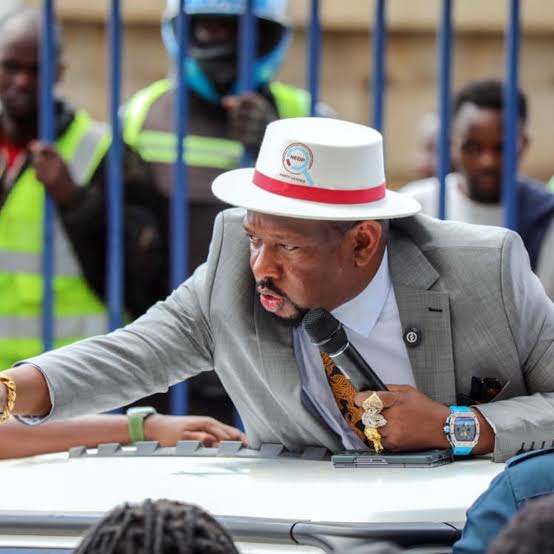

Former Nairobi Governor Mike Sonko has questioned what he describes as an “ambush” by the Supreme Court in the handling of his impeachment case, raising fresh concerns over the events that preceded the court’s decision.
Speaking on Spice FM on Thursday, Sonko narrated what he termed as “grave and suspicious” circumstances surrounding the hearing of his appeal, insisting that the Supreme Court failed to give due consideration to related proceedings that were before the High Court in Mombasa.
According to Sonko, the sequence of events raised serious questions about the manner in which his case was handled.
He claimed that on July 12, 2022—just a day before the High Court in Mombasa was scheduled to deliver its judgment on July 13, 2022—Chief Justice Martha Koome directed the Deputy Registrar of the Supreme Court to issue him with a hearing notice and list his appeal for hearing on July 14, 2022.
Sonko said the Deputy Registrar informed him that the matter had been certified as urgent and was therefore being fast-tracked for hearing.
The former governor argued that the move suggested the Supreme Court anticipated he could receive a favourable judgment from the Mombasa High Court, prompting the appellate court to intervene before that decision was delivered.
Indeed, the Mombasa High Court Judgment Cleared Sonko to Vie for Mombasa Governor seat,ruling that Sonko was eligible to contest in the August 9, 2022 General Election.
The ruling overturned the decision that had barred his candidature. In the judgment delivered on July 13, 2022, the court found that his constitutional rights had been violated during the nomination process.
The three-judge bench comprising Justices Olga Sewe, Stephen Githinji and Anne Adwera-Ong’injo declared that Sonko was eligible under Articles 180(2) and 193(3) of the Constitution to vie for governor position.
The judges also held that the respondents had violated several constitutional provisions, including Articles 20, 27, 38, 47 and 259(1), in handling his nomination.
The court further quashed the decision by the Independent Electoral and Boundaries Commission (IEBC) and the Dispute Resolution Committee that had disqualified Sonko from the race.
It also issued an order compelling the electoral commission to accept his nomination papers, while directing each party to bear its own legal costs.
But the Supreme Court was at the same time battling to schedule the hearing and determination of his appeal at the same time,a move the former Governor is poking holes in.
The Supreme Court issued strict timelines in Sonko’s through directions dated July 11, 2022.
It set strict timelines for the hearing of the petition against the Clerk of the Nairobi City County Assembly and 11 other respondents.
The court noted that the matter was urgent and that a ruling on the preliminary objection had already been delivered, necessitating an expedited hearing process.
Under the directions signed by Supreme Court Deputy Registrar L.M. Wachira, the respondents were ordered to file and serve their responses by the close of business on July 12, 2022.
At the same time, Sonko was granted until midday on July 13, 2022, to file any rejoinder, after which the petition was scheduled for hearing before a five-judge bench on July 14, 2022, at 9:00 a.m.
Sonko would immediately protest the Supreme Court directions, warning of miscarriage of justice.
Through his lawyers,Sonko argued that the court had issued directions that denied him a fair opportunity to respond to issues raised by the respondents.
In a letter dated July 12, 2022, his lawyers, wrote to the Registrar of the Supreme Court concerning Petition E11 (E008) of 2022.
He argued that after the respondents filed an application seeking to strike out the petition, the court proceeded to issue directions before the respondents had filed their substantive responses.
He further argued that without those responses, he could not prepare a rejoinder or a supplementary affidavit to address new issues likely to arise, saying the court’s directions wrongly assumed that all pleadings and submissions had already been filed.
In the protest letter, Sonko’s legal team warned that bypassing these procedural steps was likely to result in a serious miscarriage of justice against the petitioner.
They urged the Supreme Court to revise its directions to allow the respondents to first file their responses before granting Sonko sufficient time to prepare any supplementary affidavit and consult his legal counsel for a proper rejoinder.
They pleaded with the court to allow the usual legal procedures to prevail, arguing that the matter was not only about Sonko’s individual rights but also concerned the protection of the sovereignty of the people of the Republic of Kenya.
The Supreme Court would later apologise to Sonko, admitting that it had made an inadvertent procedural mistake while handling the impeachment appeal.
In a letter dated July 12, 2022, the court acknowledged that although directions had been issued on July 11, 2022, they had inadvertently failed to include directions relating to the petitioner’s filing of submissions in support of his.
The letter expressed regret over the oversight and informed the parties that fresh directions had been enclosed to ensure compliance and allow the matter to proceed fairly.
” It has come to our attention that due to inadvertent mistake,directions were not issued in respect to the petitioner filing submissions in support of the petition,” theetter reads.
It further reads: ” We apologise for the oversight and hereby enclose further directions for compliance by the parties,”
The Supreme Court issued further directions setting new timelines for submissions by all parties.
The directions, dated July 12, 2022, ordered Sonko to file and serve a soft copy of his submissions by midnight on July 12 the same day.
The respondents were granted until 10:00 a.m. on July 13, 2022, to file any supplementary submissions, while Sonko was allowed to file any rejoinder by noon the same day.
The court further directed that all hard copies of the filed responses and submissions be available at the Supreme Court registry by 2:00 p.m. on July 13, 2022, paving the way for the matter to proceed.
However,Sonko still found the timelines unreasonable and deliberately set to deny all parties adequate time to prepare.
According to Sonko, the appeal involved 14 parties, making it practically impossible to file affidavits, prepare written submissions and serve all respondents within the limited period provided.
He maintained that all parties should have been granted between seven and 14 days to file and exchange submissions in accordance with fair hearing principles.
Sonko also alleged that the Supreme Court departed from its own procedural rules governing appeals by listing the matter on short notice.
This would later be confirmed by the East African Court of Justice (EACJ) which criticized Kenya’s Supreme Court over how it handled f Sonko’s impeachment case.
The regional court acknowledged that there were credible allegations of procedural irregularities that deserved to be heard.
The EACJ found that Sonko’s claims raised substantial issues, citing possible violations of Article 25 of the Kenyan Constitution, which protects the right to a fair trial, as well as Articles 6 and 7 of the East African Community Treaty, which require partner states to uphold the rule of law, good governance, accountability, and justice.
The court observed that the Supreme Court’s decision to permanently bar Sonko from elective office had caused “irreparable harm” to his political career and reputation.
It stated that such a severe penalty required strict adherence to due process and procedural fairness throughout the judicial proceedings.
Kenya’s Attorney General had argued that the regional court has no jurisdiction over the matter but the court found that existing treaties gives it mandate.
Sonko has consequently questioned the Supreme Court’s advisory opinion issued following the request by the Attorney General on impeachment procedures.
The former Governor is expected to pursue a fresh legal challenge over issues arising from his impeachment case as he strives to have his eligibility to contest solved.
He is set to seek a review of the entire process even as he prepares his National Economic Development Party ( NEDP) for the 2027 elections.